Equipment works harder when the space around it is kept clean. Dust settles on machine housings, oil mist collects on guards, food residue builds up around cooking equipment and packaging fibres gather at line edges. Over time, those small deposits make the workplace harder to inspect, clean and present. Our guide to why dust builds up in Sydney offices explains where it gathers and why it returns.
KV Office Cleaning provides commercial equipment cleaning in Sydney for manufacturing plants, workshops, production facilities, commercial kitchens, warehouses and plant rooms. The service focuses on accessible equipment exteriors, surrounds, floors and shared work areas, with the scope agreed around your site.
Our equipment cleaning services in Sydney can be arranged as a recurring routine, a periodic deep clean or a one-off project. Industrial equipment cleaning, industrial machinery cleaning, heavy equipment cleaning and manufacturing equipment cleaning can each be planned around production windows, access rules and the way your team works.
From a single commercial kitchen to a multi-line production site, we start with the asset list and the cleaning boundary, then build a practical task schedule around them.
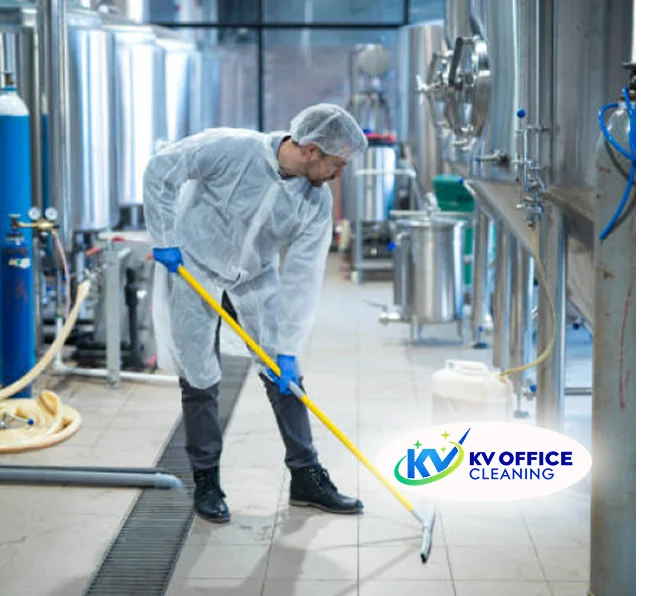
Equipment cleaning is different from mechanical maintenance. The task list identifies the external surfaces, surrounding floors and shared areas that can be cleaned safely, then assigns a suitable method and frequency to each item.
Cleaning of accessible machine housings, frames, guards and panels around production equipment, with the site confirming the approved boundary.
Removal of dust, loose material and residue from floors, walkways and service areas around fixed plant and machinery.
Attention to accessible line frames, conveyor surrounds, packing stations and transfer points included in the agreed task list.
External cleaning of agreed ovens, fryers, grills, fridges, shelving, benches and extraction surrounds in staff and hospitality kitchens.
Exterior washing of mobile plant, forklifts and fixed equipment where access, drainage and wash-water arrangements are suitable.
Cleaning of workbenches, tool-storage exteriors, shelving and shared workshop surfaces included in the service scope.
Wipe-down of approved external bases, guarding, castors, legs and control-panel exteriors after the site confirms safe access.
Cleaning around equipment footprints, drip areas, bunded zones and the routes operators use to reach each asset.
Internal machine cleaning, dismantling, electrical work and mechanical servicing remain with the site's authorised maintenance team.
Equipment cleaning can be planned as part of a regular housekeeping routine or booked around a specific event. The right timing depends on the residue being produced, the access available and the way the site operates.
For some businesses, the priority is keeping high-use equipment and operator routes presentable. For others, the driver is a changeover, an audit, a fit-out handover or a kitchen that needs a deeper exterior clean. Our comparison of spring cleaning and periodic detailed cleaning explains how to separate the two.
A site review helps separate routine tasks from periodic work, so the cleaning team can focus on the right areas during each visit.
Some equipment and access routes collect residue faster than others. The area beside a main walkway, the packing station at the end of a line and the kitchen pass during service all receive more traffic and more deposits.
A longer cleaning window gives the site time for equipment bases, lower panels, floor edges, storage interfaces and nominated high-level surfaces.
Periodic work can be planned alongside routine cleaning or scheduled during a shutdown, changeover or maintenance period.
Every asset has a different cleaning boundary. The plan should make that boundary clear before the first visit, so the cleaning team, production staff and maintenance team all work from the same instructions.
Machinery surrounds collect the material a process produces: metal dust, coolant mist, flour, sugar, plastic granules, cardboard fibres or general workshop dirt. Cleaning starts with the residue and the surface, not a standard mop-and-wipe routine. The site confirms which guards, panels and floor zones can be accessed, and the cleaning sequence follows the production timetable.
Commercial kitchens need a cleaning plan that keeps cooking equipment, preparation benches and shared surfaces presentable without disrupting service. Agreed external surfaces of ovens, fryers, grills, refrigerators, shelving and extraction surrounds can be included, along with kitchen floors, wall surfaces and staff change areas. The adjoining lunchroom and staff kitchen can be covered under office kitchen cleaning. Where internal parts or exhaust ductwork are required, they are assessed and quoted as a separate task.
Forklifts, mobile plant, trailers, compactors and fixed equipment can carry dust, oil, mud and product residue into shared areas. Exterior washing can be scoped where the site has a suitable wash area, drainage and containment for the water used. Equipment that cannot be moved is cleaned in place, with the surrounding floor and access route included in the task list.
Manufacturing equipment cleaning can cover machine exteriors, control-panel faces, guarding, bases, castors, workbenches and the floors between assets. Production teams often know which areas collect the most residue, so their input helps set the priorities. Stainless steel, painted metal, plastic, rubber and coated floors are matched with suitable products to protect the finish.
A single site may use more than one schedule. High-use equipment and floors might be cleaned daily, while equipment bases, high-level surfaces and less accessible areas are added to a periodic or shutdown list.
Clean agreed equipment exteriors and surrounds before the first shift or production run begins.
Use a shift change to attend busy equipment zones and shared work areas without stopping the line.
Plan deeper work around product or line changeovers when equipment access is available.
Set a recurring exterior clean for high-use equipment, floors and operator routes.
Schedule a longer clean for accumulated residue, equipment bases and hard-to-reach surrounds.
Coordinate detailed cleaning with planned maintenance, isolation and restart dates.
Arrange evening or overnight access where the building and site procedures allow.
Book a single clean for a site move, fit-out handover, post-maintenance work or a specific asset.
Share your shift calendar, changeover periods and planned maintenance dates so the cleaning sequence can be built around the windows available at your site.
A clear checklist defines which equipment, surfaces and surrounds are included, how access will be managed and which tasks need particular attention.
Identify the equipment, surrounds and shared areas to be included, with photos or a site walk where possible.
Confirm which external surfaces the cleaning team can access and which areas remain with maintenance or site staff.
Select suitable products, tools and techniques for stainless steel, painted metal, plastic, rubber, glass and floor finishes.
Agree inductions, PPE, isolation points, exclusion zones and the supervisor who will release each area.
Build the visit frequency, production windows, inclusions and any periodic or shutdown work into one plan.
Check completed areas against the agreed list and update the scope when equipment, layouts or operating hours change.
KV Office Cleaning helps Sydney businesses arrange equipment cleaning around their facilities, access requirements and preferred service times. The scope is agreed before work begins, so the site contact knows which assets and tasks are included.
Before the service begins, we establish the cleaning scope and discuss practical requirements such as:
Share the equipment list, priority assets and preferred schedule. We can then confirm the requested scope and whether it fits the service arrangements available for your site.
For industrial plant cleaning, the task list can group fixed equipment, service rooms and production support assets separately from the main line. This keeps access requirements and cleaning frequencies clear for each area.
Sydney's workplaces range from small kitchens and workshops to large production and logistics sites. The cleaning priorities should reflect the equipment, residue and operating pattern of each facility.
Production equipment, line surrounds, walkways and shared work areas planned around output and shift patterns.
Equipment exteriors, cooking surrounds, benches and floors in hotels, clubs, cafes and staff kitchens.
Forklifts, conveyors, packing equipment, charging areas and transfer routes included in the agreed scope.
Bench surrounds, machine exteriors, storage areas and floors where dust, swarf and oil marks collect.
Accessible equipment exteriors and production surrounds cleaned to the site's hygiene and access instructions.
Agreed external surfaces, floors and access routes around pumps, compressors, tanks and utility equipment.
Equipment cleaning can sit alongside office kitchen cleaning, office floor cleaning and office deep cleaning.
For sites with public or secure access requirements, see airport cleaning services and bank cleaning services.
For a deeper checklist, read seven signs your Sydney office needs a deep clean.
KV Office Cleaning has provided commercial cleaning services across Sydney since 2004. Our approach is built on a clear scope, practical scheduling and a team that understands how cleaning fits around a working site.
Sydney's industrial and commercial footprint stretches from Alexandria, Marrickville and Botany through to Smithfield, Wetherill Park, Eastern Creek, Blacktown and Penrith. Food production, engineering workshops, logistics sites and hospitality kitchens all bring different equipment and cleaning challenges.
KV Office Cleaning works with businesses across the Sydney metropolitan area. Share your suburb and site details so the team can confirm service coverage and availability.
Answers to common questions about commercial equipment cleaning, access, scheduling and quotes in Sydney.
The scope can cover accessible equipment exteriors, frames, guards, bases, control-panel exteriors, surrounding floors, drip zones and shared work areas. We agree the asset list, cleaning boundary and tasks before the first visit.
Some external cleaning can be completed alongside production when the site confirms safe access and the work area is separated from operators. Equipment that needs guarding removed, internal access or isolation is scheduled during a changeover, shutdown or maintenance window.
Yes. We can clean agreed external surfaces of ovens, fryers, grills, refrigerators, shelving, benches, canopies and extraction surrounds, along with kitchen floors and wall surfaces included in the scope. Internal dismantling and exhaust ductwork are quoted separately where required.
Frequency depends on the residue, production hours, hygiene requirements and how quickly build-up returns. Many sites combine a daily or weekly exterior routine with periodic deep cleaning and shutdown work.
Share the Sydney suburb, facility type, equipment list, surface materials, residue type, access conditions, preferred hours and any site inductions or isolation requirements. Photos of the equipment and surrounds also help.
Tell us what equipment needs attention, where your site is and how the work can fit around production. We can then discuss the scope and a suitable service arrangement.
For a more accurate quote, please share:
Photos of the equipment and surrounding area are helpful if a site visit has not yet been arranged.